

Views: 0 Author: Site Editor Publish Time: 2026-10-28 Origin: Site


Solar tracking systems use drive mechanisms to adjust panel angles as the sun moves across the sky. The choice of drive affects system layout, load handling, maintenance, and project cost. For engineers and procurement teams, selecting the right mechanism means balancing structural requirements with operating conditions and long-term service needs.
When comparing a linear actuator vs. slew drive, there is no universal winner. A linear actuator produces push-pull motion that can be converted into rotation through a linkage. A slew drive delivers rotary motion through a geared mechanism. The better option depends on tracker architecture, required force or torque, wind-stow loads, positioning accuracy, and maintenance access.
Table of Contents
Evaluation factor | Linear actuator | Slew drive |
|---|---|---|
Output motion | Linear push-pull motion | Direct rotary motion |
System connection | Usually uses a lever or linkage to rotate the tracker | Often connects directly to a rotating structure |
Main sizing factor | Thrust, stroke, mounting geometry, and buckling resistance | Output torque, bearing loads, gear design, and mounting strength |
Positioning performance | Depends on actuator design, feedback, and controller | Depends on gear backlash, feedback, and controller |
Installation | Requires suitable mounting points and linkage geometry | Requires a compatible mounting interface and structural support |
Maintenance focus | Seals, moving rod, screw mechanism, and lubrication where specified | Gear lubrication, seals, bearing condition, and gear wear |
Typical design consideration | Distributed or linkage-based drive layouts | Compact rotary drive layouts with suitable torque requirements |
Neither technology automatically provides better precision, lower maintenance, or higher wind resistance. These outcomes depend on the selected model and the complete tracker design.
A linear actuator converts motor power into straight-line movement. Depending on its design, it may use a screw mechanism or another transmission system to extend and retract a rod.
In a solar tracker, the actuator is connected to the structure through mounting brackets and a lever arm or linkage. When the actuator extends or retracts, the linkage converts this movement into a change in panel angle. The actuator’s required thrust and stroke depend on the geometry, movement range, and loads acting on the array.
Linear actuators can be used in different single-axis and dual-axis tracking arrangements. For example, Powernice offers solar tracker linear actuators for various tracker configurations.
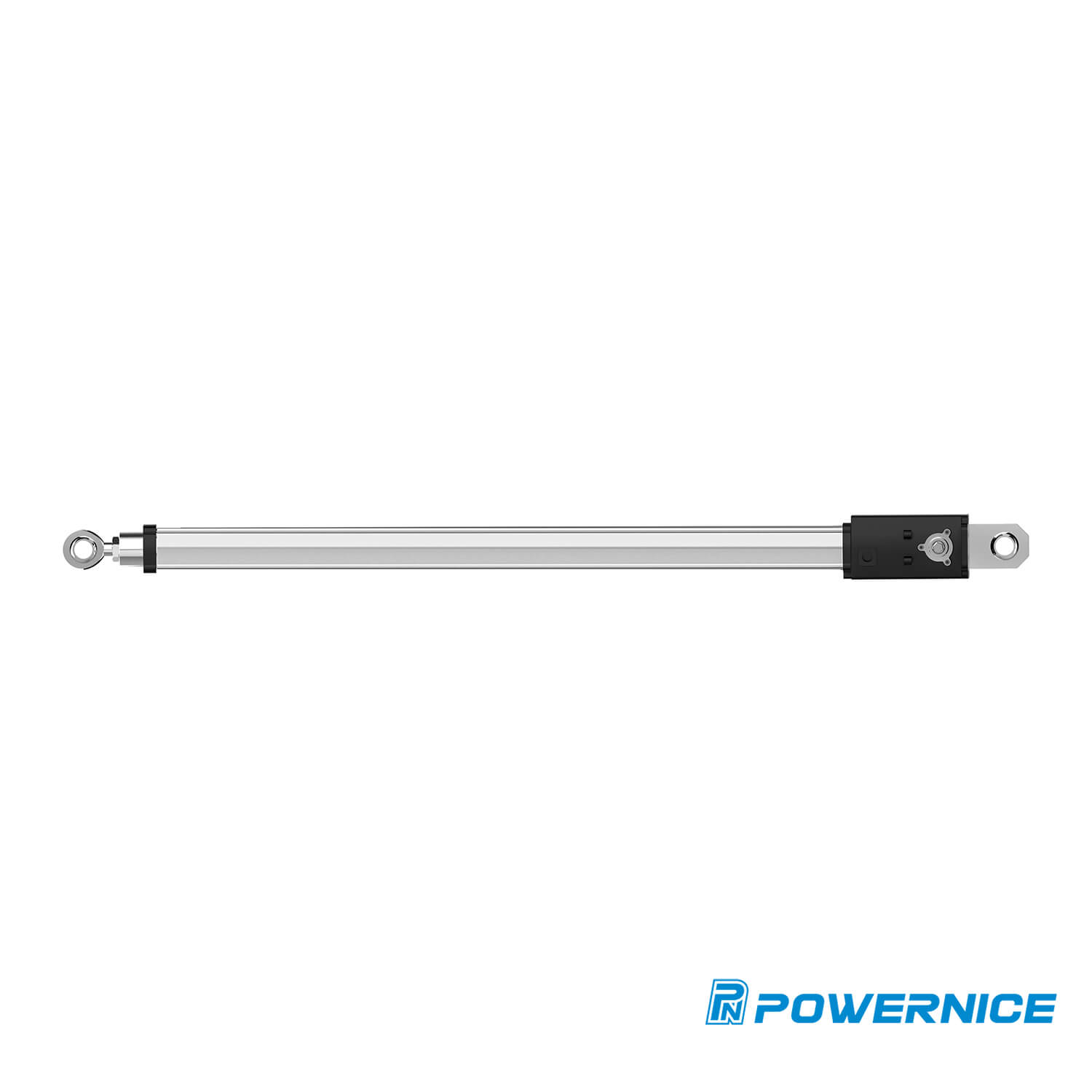
When selecting a linear actuator, engineers should check:
Rated thrust under the required operating conditions
Stroke length and installation dimensions
Compression and buckling limits
Duty cycle and movement speed
Position feedback and control compatibility
Environmental protection and maintenance requirements
A linear actuator should not be assumed to hold any load safely when power is removed. Holding performance depends on the transmission, brake, load direction, and system design.
A slew drive is a rotary drive assembly that commonly combines a geared transmission with a bearing structure. A motor turns the input shaft, and the internal gearing rotates the output ring or platform. This arrangement produces rotary movement without requiring an external lever to convert linear motion.
In a tracker, a slew drive may be mounted between the supporting structure and the rotating assembly. It can provide controlled rotation while supporting loads within its rated limits. The actual capacity depends on the drive model, bearing design, gear configuration, mounting conditions, and load direction.
Slew drives are often considered when a design needs a compact rotary mechanism. However, the drive’s rated torque alone does not establish whether it can withstand all wind loads. Engineers must also evaluate bearing loads, structural deflection, mounting bolts, and the tracker’s stow strategy.
A worm-gear slew drive should not automatically be treated as self-locking. Whether it resists back-driving depends on the gear design, friction, loading, and operating conditions. Where required, a brake or additional locking method should be included in the system design.
During normal tracking, the drive moves the array slowly. During high winds, however, the structure may experience substantial aerodynamic forces. The tracker must move to and maintain its designated stow position according to its control strategy and structural design.
For linear actuators, engineers should calculate the force generated by the panel loads and linkage geometry. They should also check the actuator’s compression limit, buckling resistance, mounting pins, and brackets.
For slew drives, the design review should include rated output torque, axial and radial loads, tilting moment, gear strength, bearing capacity, and mounting strength. A high holding-torque rating by itself does not prove that the complete tracker can withstand a particular wind event.
The final selection should be based on the tracker manufacturer’s structural calculations and the project’s site-specific wind conditions.
Backlash is mechanical clearance between components in a transmission. Excessive backlash can cause a difference between commanded movement and actual movement, especially when the load changes direction.
Slew drives may have measurable gear backlash, depending on their design and manufacturing tolerances. Wear, mounting conditions, and loading can also affect performance over time.
Linear actuators can provide repeatable positioning, but their accuracy is not automatically higher than that of rotary drives. Performance depends on screw and gearbox tolerances, mounting geometry, position sensors, controller settings, and structural flexibility.
For most photovoltaic tracking systems, evaluate the accuracy of the complete tracking system rather than comparing actuator types in isolation. Concentrated solar applications may have different optical requirements and should be assessed separately from conventional photovoltaic trackers.
Solar trackers operate outdoors and may be exposed to dust, sand, rain, humidity, temperature changes, and corrosive conditions.
For linear actuators, inspect the rod seals, wipers, housing, cable entries, and any exposed moving components. Dirt or ice around an extending rod can affect movement or damage seals.
For slew drives, review the housing, rotary seals, lubrication system, bearing protection, and corrosion resistance. An enclosed housing can protect internal components, but it does not eliminate the need for suitable sealing and maintenance.
Choose the required ingress protection rating based on the installation environment and the manufacturer’s specifications. Do not assume that IP65 or IP67 is mandatory for every solar tracker.
Linear actuator maintenance may include checking seals, mounting points, fasteners, electrical connections, lubrication requirements, and signs of abnormal wear. A replaceable actuator can simplify service when the mounting design allows safe access.
Slew drive maintenance may include checking lubrication, seals, fasteners, bearing condition, gear wear, and unusual noise or movement. Replacement complexity depends on the drive location, tracker layout, lifting requirements, and access to the rotating structure.
Neither drive type has a guaranteed service life based on its category alone. Ask suppliers for model-specific service guidance, test information, warranty terms, and recommended inspection intervals.
Single-axis trackers rotate panels around one axis. Their drive arrangement may use a central drive, a linked mechanical system, or distributed drives across independent rows.
Linear actuators can be suitable for designs that convert linear movement into rotation through linkages. Their selection depends on the required thrust, stroke, linkage geometry, and row configuration.
Slew drives may suit designs that require rotary output at a central or local drive point. Engineers should compare the torque requirement, structural support, drive count, and maintenance access for the complete layout.
Do not assume that every utility-scale single-axis tracker uses a slew drive or that every distributed design uses a linear actuator. The tracker architecture determines which options are practical.

Dual-axis trackers adjust panel orientation around two axes. Some designs use a rotary drive for one axis and a linear actuator for the other, while other arrangements use different drive combinations.
A slew drive may be considered for an axis requiring controlled rotary movement. A linear actuator may be suitable where a linkage provides the required tilt movement. The choice depends on the loads, travel range, accuracy target, and mechanical layout.
Concentrated photovoltaic and concentrated solar thermal systems can have more demanding pointing requirements than conventional PV systems. Their optical design, tracking tolerance, and safety requirements should be assessed separately. Neither drive type should be described as mandatory for all such systems.
The total cost of a solar tracking drive system includes more than the price of an individual component. Engineers should compare:
Drive and motor costs
Number of drives required
Brackets, linkages, bearings, and supporting steel
Electrical connections and control equipment
Installation time and lifting requirements
Scheduled inspections and replacement parts
Expected downtime and access costs
A linear actuator may have a lower unit price in some configurations, but a design may require multiple actuators and linkages. A slew drive may cost more per unit, but it may simplify the rotary connection in a suitable layout. Neither option is always cheaper per megawatt.
The most useful comparison is a project-specific total cost of ownership estimate that includes the expected drive count, maintenance plan, replacement strategy, and energy-production risks.
Wind loads can cause the tracker structure to bend or twist. Excessive deflection may affect alignment and increase stress on drive components.
Before choosing a drive, review the structural model, load combinations, stow strategy, mounting points, and torque-tube or linkage deflection. The location and number of drives should follow engineering calculations rather than a general rule.
Mounting dimensions, stroke length, bolt patterns, electrical interfaces, and control signals can differ between suppliers. Confirm these details before standardizing a design or ordering replacement units.
Where long-term availability matters, ask suppliers about spare-part support, lead times, documentation, and whether alternative components can meet the same technical requirements. Do not assume that different models are interchangeable because they have similar dimensions.
Use this checklist before finalizing a solar tracker drive:
Define the tracker architecture and required movement range.
Calculate operating loads and site-specific wind-stow loads.
Verify thrust or torque, mounting loads, and structural limits.
Set positioning accuracy and feedback requirements.
Confirm environmental protection and maintenance access.
Compare total system cost, drive count, replacement time, and spare-part availability.
Request model-specific technical documents and validation data from suppliers.
For product options, explore Powernice’s solar tracker linear actuator range. Confirm that any selected model meets the project’s load, stroke, control, and environmental requirements.
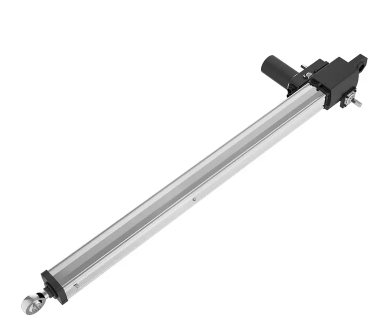
The choice between a linear actuator and a slew drive depends on the tracker’s mechanical layout and operating requirements. Linear actuators provide push-pull motion that can be converted into rotation through a linkage. Slew drives provide geared rotary motion for suitable tracker designs.
Compare both options using project-specific load calculations, positioning requirements, environmental conditions, installation constraints, and lifecycle costs. The best choice is the mechanism that meets the complete system requirements—not simply the one with the highest advertised force or torque.
A linear actuator produces straight-line push-pull motion, usually converted into rotation through a linkage. A slew drive produces rotary motion through a geared mechanism.
Neither type is automatically better. The complete tracker must meet site-specific wind-load and stow requirements, including drive capacity, mounting strength, structural deflection, and any required braking or locking method.
Not in every application. Positioning accuracy depends on mechanical tolerances, backlash, feedback sensors, control settings, mounting geometry, and structural flexibility.
Maintenance depends on the model and operating environment. Linear actuators may need checks of seals and moving parts, while slew drives may require gear lubrication and inspection of seals, bearings, and gears.
Compare the full system cost, including drive quantity, linkages, mounting structures, installation, control equipment, maintenance, replacement, spare parts, and potential downtime.
